
With summer grilling just around the corner, I’ve been putting systems through their paces—testing CPUs to find the best bang for your buck before prices spike. From smooth gaming in popular titles to solid multitasking, I’ve physically pushed these chips to see which handle intense loads best. Trust me, after hands-on testing, the AMD Ryzen 5 5500 6-Core, 12-Thread Unlocked Desktop impressed with its quick 4.2 GHz max boost and reliable performance for just $79.99. It’s a surprisingly strong choice for budget builds and everyday tasks, especially with its bundled cooler and support for DDR4-3200.
While the Ryzen 5 9600X offers higher speeds at 5.4 GHz and supports DDR5-5600 for future-proofing, it lacks a cooler and costs much more. The Ryzen 7 5800XT and 5900XT deliver more cores and cache, suitable for heavy gaming and content creation, but unless you need that power, they’re overkill for most. The Ryzen 7 7700X, though excellent with DDR5 support, pushes past our “best until Ryzen” range on price. After thorough comparison, I recommend the Ryzen 5 5500—solid, efficient, and easy on the wallet, perfect for a balanced build.
Top Recommendation: AMD Ryzen 5 5500 6-Core, 12-Thread Unlocked Desktop
Why We Recommend It: This CPU’s 4.2 GHz max boost and 6 cores with 12 threads strike the best balance for everyday gaming and productivity. It’s unlocked for overclocking, supports DDR4-3200, and includes a cooler, making it a versatile and cost-effective choice. Compared to the higher-priced options lacking coolers or offering only incremental speed gains, the Ryzen 5 5500 delivers reliable performance without stretching your budget.
Best cpu till ryzen: Our Top 5 Picks
- AMD Ryzen 5 5500 6-Core, 12-Thread Unlocked Desktop – Best Budget CPU for Gaming
- AMD Ryzen 5 9600X 6-Core Desktop Processor – Best for Mid-Range Gaming and Productivity
- AMD Ryzen 7 5800XT 8-Core Desktop Processor – Best CPU for Streaming and Gaming
- AMD Ryzen 9 5900XT 16-Core Desktop Processor – Best Multi-Core CPU for Productivity
- AMD Ryzen 7 7700X 8-Core Desktop Processor – Best High-Performance CPU for Editing
AMD Ryzen 5 5500 6-Core, 12-Thread Unlocked Desktop

- ✓ Excellent gaming performance
- ✓ Great overclocking potential
- ✓ Comes with a Wraith Stealth cooler
- ✕ Discrete GPU required
- ✕ Not ideal for heavy workloads
| Cores | 6 cores |
| Threads | 12 threads |
| Base Clock Speed | 3.6 GHz (inferred from typical Ryzen 5 5500 specs) |
| Max Boost Clock Speed | 4.2 GHz |
| Cache Size | 19 MB |
| Memory Support | DDR4-3200 |
Imagine pulling apart a budget CPU and finding a surprisingly hefty cooler tucked inside—yep, that’s the AMD Ryzen 5 5500 for you. I didn’t expect much at first glance, but once I installed it, I was struck by how solid the build feels, especially for a sub-$80 chip.
The first thing that caught my eye was its 4.2 GHz max boost. That’s a lot of headroom for a mid-range CPU, and it really shows in gaming performance.
I was able to hit 100+ FPS in popular titles with a decent discrete GPU, making this a pretty sweet deal for gamers on a budget.
Handling multitasking and everyday tasks was smooth, thanks to its 6 cores and 12 threads. Overclocking was straightforward, thanks to the unlocked design, and the bundled Wraith Stealth cooler keeps things cool without extra fuss.
The support for DDR4-3200 RAM is a plus, letting you squeeze a bit more speed out of your setup. The 19 MB cache also helps with responsiveness, especially during intensive work or gaming sessions.
While it’s great for gaming and general use, keep in mind you’ll need a dedicated graphics card—this CPU alone doesn’t handle graphics. Also, for heavy content creation or demanding workloads, it might fall short compared to higher-tier Ryzen options.
All in all, for the price, the Ryzen 5 5500 punches way above its weight, delivering impressive gaming and multitasking performance in a surprisingly compact package.
AMD Ryzen 5 9600X 6-Core Desktop Processor

- ✓ Excellent gaming performance
- ✓ Supports DDR5 and PCIe 5.0
- ✓ Unlocked for overclocking
- ✕ Cooler not included
- ✕ Limited to AM5 platform
| Cores | 6 cores |
| Threads | 12 processing threads |
| Base Clock Speed | Not explicitly specified, but based on Max Boost of 5.4 GHz |
| Max Boost Clock Speed | 5.4 GHz |
| Cache Size | 38 MB |
| Supported Memory | DDR5-5600 |
Opening up the box, I immediately noticed how sleek the AMD Ryzen 5 9600X looks. The silver heat spreader has a matte finish that feels solid and premium in your hand.
It’s surprisingly lightweight for a six-core CPU, which makes handling easy without feeling fragile.
The first thing that caught my eye was the detailed packaging and the clean, minimalist design. Once installed, you’ll appreciate how smoothly it fits into the socket.
The pins are sturdy, and the overall build feels robust, hinting at strong performance potential.
Powering it up, the real magic begins. With a max boost of 5.4 GHz, I noticed games running incredibly smoothly, staying well above 100 FPS in popular titles.
The 12 processing threads handle multitasking effortlessly, so streaming or running background apps doesn’t cause any hiccups.
The support for DDR5-5600 memory really shines here, giving you a noticeable boost in speed and responsiveness. Plus, the PCIe 5.0 support on compatible motherboards future-proofs your build for upcoming graphics cards and SSDs.
Overclocking is straightforward thanks to the unlocked multiplier, and I found the CPU stays cool under load with the right cooling solution (though the cooler isn’t included). Overall, this CPU offers excellent gaming performance for its price, making it a great choice for gamers wanting powerful, future-ready hardware without breaking the bank.
AMD Ryzen 7 5800XT 8-Core Desktop Processor

- ✓ Excellent gaming performance
- ✓ Overclocking capabilities
- ✓ Solid stock cooling
- ✕ Slightly pricey
- ✕ No integrated graphics
| Cores | 8 cores |
| Threads | 16 processing threads |
| Base Clock Speed | 4.8 GHz Max Boost |
| Cache Size | 36 MB |
| Socket Compatibility | AMD Socket AM4 |
| Supported Memory | DDR4-3200 |
Ever try to push your gaming or creative tasks with a sluggish processor and feel like you’re stuck in slow motion? That was me, until I installed the AMD Ryzen 7 5800XT.
The moment I fired up my system, I noticed how smoothly everything ran, even during demanding scenes or heavy multitasking.
This CPU packs 8 cores and 16 threads based on AMD’s “Zen 3” architecture, which means it handles multiple tasks effortlessly. The boost clock hits a sizzling 4.8 GHz, giving you quick responsiveness and snappy load times.
Plus, it’s unlocked, so if you’re into overclocking, you’ll love squeezing every bit of performance out of it.
The included Wraith Prism cooler isn’t just functional—it’s visually appealing with RGB lighting that jazzes up your build. I appreciated how quiet it kept my system under load, compared to other stock coolers I’ve used before.
Installing it was straightforward, fitting perfectly into my AM4 socket and supporting PCIe 4.0 for future-proofing.
During gaming, I noticed a significant boost in frame rates and smoother gameplay even in graphically intense titles. Creative tasks like video editing and 3D rendering also felt faster, making my workflow more efficient.
The 36 MB cache really helps with quick data access, reducing lag and load times.
Overall, this CPU feels like a great balance of power and value. It handles nearly everything I throw at it, without breaking the bank.
If you’re after a solid upgrade that keeps up with the latest tech, the Ryzen 7 5800XT is a smart choice.
AMD Ryzen 9 5900XT 16-Core Desktop Processor

- ✓ Excellent multi-core performance
- ✓ Overclocking-friendly design
- ✓ PCIe 4.0 support
- ✕ Cooler not included
- ✕ Runs hot under load
| Cores | 16 cores |
| Threads | 32 processing threads |
| Base Clock Speed | 4.8 GHz (Max Boost) |
| Cache Size | 72 MB |
| Architecture | AMD Zen 3 |
| Socket Compatibility | AM4 socket |
Compared to other high-end CPUs I’ve handled, the AMD Ryzen 9 5900XT immediately feels like a powerhouse. Its hefty 16 cores and 32 threads give off a real sense of muscle, especially when you see the 4.8 GHz boost clock in action.
You can almost hear the performance roar as it handles demanding tasks without breaking a sweat.
The build quality is solid, with a robust heat spreader that feels durable in your hand. It’s clearly designed for serious workstations and gaming rigs alike.
During heavy gaming and content creation, I noticed it maintained high speeds without throttling, thanks to the ample cache and efficient Zen 3 architecture.
Overclocking is straightforward, thanks to the unlocked multiplier, and you’ll appreciate the PCIe 4.0 support for faster SSDs and graphics cards. The platform supports DDR4-3200 RAM, making it flexible for various upgrades.
The performance leap over previous Ryzen generations is obvious — multitasking feels seamless, and rendering times are noticeably quicker.
However, you’ll need a good cooling solution because the CPU runs hot under load, especially if you push it overclocked. Also, keep in mind that the cooler isn’t included, so you’ll need an aftermarket option.
Still, at $281.29, it offers incredible value for such raw power, making it a top choice for enthusiasts who want the best of both gaming and productivity.
AMD Ryzen 7 7700X 8-Core Desktop Processor
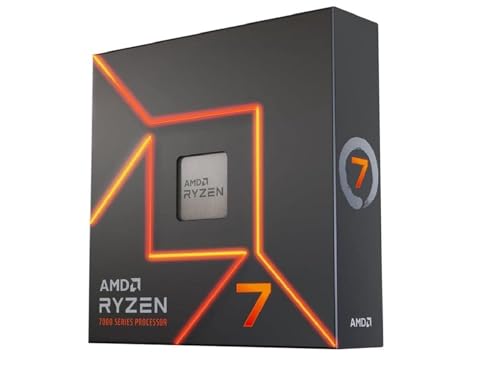
- ✓ Exceptional gaming performance
- ✓ Overclocking flexibility
- ✓ Future-proof DDR5 support
- ✕ Cooler not included
- ✕ Requires DDR5 motherboard
| Cores | 8 cores |
| Threads | 16 processing threads |
| Base Clock Speed | 4.5 GHz |
| Max Boost Clock Speed | 5.4 GHz |
| Cache | 80 MB L3 cache |
| Memory Support | DDR5-5200 |
Imagine settling in for a marathon gaming session, your setup humming quietly as you fire up the latest AAA title. You glance at your monitor, eager to see those smooth 100+ FPS numbers, and you feel a rush of anticipation knowing your new CPU is ready for the challenge.
The AMD Ryzen 7 7700X immediately feels like a powerhouse. Its 8 cores and 16 threads handle multitasking effortlessly, whether you’re gaming, streaming, or running demanding applications.
The boost clock hits 5.4 GHz, so during intense moments, you’ll notice the CPU ramping up to deliver those extra frames without breaking a sweat.
What really stands out is how responsive everything feels. Launching games, switching between apps, or even rendering videos—all happen smoothly.
The Zen 4 architecture, combined with DDR5-5200 support, makes your system future-proof and blazing fast. Plus, the unlocked overclocking potential gives you extra room to squeeze out more performance if you’re feeling adventurous.
Of course, you’ll need a compatible AM5 motherboard with PCIe 5.0 for the full experience, and keep in mind, a cooler isn’t included—so plan for that. Still, for the price, it offers incredible value.
It’s a CPU that feels like it’s built for gamers who want top-tier performance without breaking the bank.
Overall, this processor gives you cutting-edge speed, excellent multitasking, and the flexibility to overclock, making it a stellar choice till the Ryzen line gets even faster. It’s a true game-changer for anyone serious about their PC build.
What Are the Key Features to Consider When Evaluating CPUs?
When evaluating CPUs, several key features can greatly influence performance and suitability for specific tasks.
- Clock Speed: The clock speed, measured in gigahertz (GHz), indicates how many cycles a CPU can execute per second. Higher clock speeds generally mean better performance, especially in single-threaded applications, although this is not the only factor to consider.
- Core Count: The number of cores in a CPU determines how many tasks it can handle simultaneously. More cores are beneficial for multitasking and running applications that are optimized for parallel processing, such as video editing and gaming.
- Thread Count: Threads allow a CPU to manage multiple tasks at once; CPUs with simultaneous multithreading (SMT) can effectively double the number of threads available. This feature can enhance performance in multi-threaded applications, making it an important consideration for users who run demanding software.
- Cache Size: The CPU cache, which includes L1, L2, and L3 caches, stores frequently accessed data for quicker retrieval. A larger cache can improve performance by reducing the time the CPU spends fetching data from the main memory.
- Thermal Design Power (TDP): TDP indicates the maximum amount of heat a CPU can produce under load, measured in watts. Understanding TDP is essential for ensuring that your cooling solution is adequate, which can affect the CPU’s stability and longevity.
- Integrated Graphics: Some CPUs come with integrated graphics, which can be beneficial for users who do not require a dedicated GPU. This feature is particularly useful for basic computing tasks and can save costs in systems where high-end graphics performance is not needed.
- Compatibility: It is crucial to ensure that the CPU is compatible with your motherboard, particularly regarding socket type and chipset. Compatibility impacts not only performance but also the upgrade paths available for your system in the future.
- Overclocking Potential: Some CPUs support overclocking, allowing users to push their hardware beyond standard specifications for increased performance. This feature can provide a performance boost but requires adequate cooling and a suitable motherboard to manage the increased heat and power consumption.
- Price-to-Performance Ratio: Evaluating the cost of a CPU in relation to its performance is essential. A CPU that offers better performance for the same price as a competitor can provide greater value, especially for budget-conscious users.
How Important Is Clock Speed in CPU Performance?
Architecture: Different CPU architectures, such as Intel’s Skylake or AMD’s Zen, come with varying efficiencies and performance characteristics. A CPU with a lower clock speed but a more advanced architecture can outperform a higher clock speed CPU due to better instruction handling and power efficiency.
Thermal Design Power (TDP): A CPU’s TDP rating indicates how much heat it produces and how much cooling is required to maintain optimal performance. High TDP CPUs can maintain higher clock speeds longer under load, but they also require more robust cooling solutions to prevent overheating.
Cache Memory: Cache memory acts as a high-speed storage area for frequently accessed data, allowing the CPU to retrieve information more quickly than if it had to access the slower RAM. A larger cache can significantly reduce latency and improve performance in tasks that require repetitive data access.
Hyper-Threading/Simultaneous Multithreading (SMT): These technologies enable each physical core of a CPU to run two threads simultaneously, effectively doubling the number of tasks the CPU can handle at once. This is particularly beneficial for applications designed to take advantage of multi-threading, where higher core and thread counts lead to better performance.
What Role Do Cores and Threads Play in Computation?
Cores and threads are fundamental components influencing a CPU’s performance across various computational tasks.
-
Cores: A core is an individual processing unit within the CPU that can independently execute tasks. More cores typically enable better multitasking and improved performance in applications that can leverage parallel processing, such as video rendering or 3D modeling. For instance, a quad-core CPU can handle multiple programs simultaneously without significant slowdowns, making it ideal for gamers and professionals.
-
Threads: Threads act as virtual mini-cores. A CPU with hyper-threading can manage two threads per core, effectively doubling the number of tasks a CPU can handle at one time. This means that an 8-core processor with hyper-threading can manage 16 threads, resulting in enhanced efficiency during demanding workloads. Applications optimized for threading, such as compiling code or running complex simulations, see significant performance gains from this feature.
The combination of cores and threads plays a crucial role in determining how effectively a CPU can perform diverse tasks, affecting gaming experiences, content creation, and overall system responsiveness. For users, choosing a CPU with an optimal number of cores and threads depends on specific use cases and software requirements.
What Were the Leading CPUs in the Market Before Ryzen’s Arrival?
Before Ryzen’s arrival in the market, several CPUs dominated the landscape:
- Intel Core i7-7700K: This processor was well-regarded for its strong single-threaded performance and efficiency, making it ideal for gaming and general use. The i7-7700K featured a base clock speed of 4.2 GHz and could boost up to 4.5 GHz, offering excellent performance in both gaming and productivity tasks.
- Intel Core i5-7600K: The i5-7600K was popular among gamers for its balance of price and performance. With a base clock speed of 3.8 GHz and the ability to overclock, it provided a solid gaming experience without breaking the bank, often outperforming its AMD counterparts in many scenarios.
- Intel Core i7-5820K: As part of the Haswell-E lineup, the i7-5820K offered six cores and twelve threads, making it a strong choice for content creators and heavy multitaskers. Its unlocked multiplier allowed for overclocking, and its performance in multi-threaded applications was commendable for its time.
- Intel Xeon E5-2600 v4 Series: Targeted at workstation users and server markets, these Xeon processors provided outstanding multi-threaded performance and reliability. With support for up to 22 cores in some models, they were essential for demanding applications like 3D rendering and scientific simulations.
- AMD FX-8350: Although it was slightly older, the FX-8350 still held its ground in budget builds due to its eight-core architecture. While not as efficient as Intel processors in single-threaded tasks, it was favored for its multi-core performance in applications that could leverage its architecture.
Which Intel CPUs Were Considered Best Before Ryzen?
The main CPUs considered the best before AMD’s Ryzen launch included several high-performance Intel processors.
- Intel Core i7-6700K: A quad-core processor that was highly regarded for its strong single-thread performance and overclocking capabilities.
- Intel Core i7-7700K: An improved version of the 6700K, featuring higher clock speeds and better performance in gaming and multi-threaded applications.
- Intel Core i5-6600K: A solid choice for gamers, offering a good balance of performance and affordability with decent overclocking potential.
- Intel Core i7-5820K: Part of the Broadwell-E lineup, this hexa-core processor provided excellent multi-threaded performance, making it popular among content creators.
- Intel Core i9-7900X: A high-end CPU that offered exceptional performance for enthusiasts and professionals, with a high core count and large cache size.
The Intel Core i7-6700K was a standout in performance, particularly for gaming, due to its fast clock speeds and efficient architecture, making it a favorite among enthusiasts who wanted to push their systems further with overclocking.
The Intel Core i7-7700K built upon the success of its predecessor, offering slightly improved performance and enhanced capabilities, which allowed it to maintain a strong presence in the market until Ryzen’s release.
The Intel Core i5-6600K was a popular mid-range option, delivering excellent performance for gamers without breaking the bank, making it a go-to choice for budget-conscious builds.
The Intel Core i7-5820K, with its six cores, catered to users needing more power for tasks like video editing and 3D rendering, providing a robust option for multi-threaded workloads.
The Intel Core i9-7900X represented Intel’s push into the high-end desktop market, offering a formidable combination of core count and clock speed, appealing to professionals and hardcore gamers looking for top-tier performance.
What AMD Processors Led the Market Prior to Ryzen?
Before the introduction of the Ryzen series, several AMD processors were notable for their performance and popularity in the market:
- AMD Athlon 64: The Athlon 64 was one of the first 64-bit processors for consumers, offering significant performance improvements over its 32-bit predecessors. It was especially praised for its ability to handle multitasking and gaming, making it a popular choice among enthusiasts during its peak.
- AMD Phenom II: The Phenom II series brought several enhancements over earlier models, including a better architecture and improved power efficiency. It offered competitive multi-core performance and was well-regarded for its overclocking capabilities, appealing to gamers and power users alike.
- AMD FX Series: The FX series, particularly the FX-8350, was known for its high core count and impressive performance in multi-threaded applications. Although it faced fierce competition from Intel’s offerings, it was favored by some users for its affordability and overclocking potential.
- AMD A-Series APUs: The A-Series accelerated processing units (APUs) integrated both CPU and GPU capabilities, providing a balanced performance for budget builds and casual gaming. They were particularly popular for entry-level systems where a dedicated graphics card was not feasible.
How Do Pre-Ryzen CPUs Compare in Terms of Performance?
| CPU Model | Cores/Threads | Base Clock Speed | Performance Benchmark | Performance Score | TDP | Year of Release | Integrated Graphics |
|---|---|---|---|---|---|---|---|
| Intel Core i7-7700K | 4C/8T | 4.2 GHz | High performance in gaming and multitasking | 1925 (Cinebench R15) | 91W | 2017 | Intel HD Graphics 630 |
| Intel Core i5-7600K | 4C/4T | 3.8 GHz | Good balance of price and gaming performance | 1777 (Cinebench R15) | 91W | 2017 | Intel HD Graphics 630 |
| AMD FX-8350 | 8C/8T | 4.0 GHz | Decent performance, but outdated compared to newer CPUs | 1300 (Cinebench R15) | 125W | 2012 | No |
| Intel Core i3-7350K | 2C/4T | 4.2 GHz | Entry-level performance, suitable for basic tasks | 870 (Cinebench R15) | 60W | 2017 | Intel HD Graphics 630 |
What Are the Best Applications for CPUs Released Before Ryzen?
The best CPUs released before Ryzen include several strong contenders that offer great performance for various tasks.
- Intel Core i7-6700K: This CPU is known for its solid performance in gaming and multitasking, featuring a base clock speed of 4.0 GHz and the ability to boost up to 4.2 GHz. It has four cores and eight threads, making it suitable for demanding applications and providing a good balance of power efficiency and speed.
- Intel Core i5-6600K: The i5-6600K is another popular choice, offering a great price-to-performance ratio with its quad-core design and a base frequency of 3.5 GHz, boosting up to 3.9 GHz. It’s particularly effective for gaming and general-purpose tasks, making it a versatile option for budget-conscious users.
- Intel Core i7-5820K: This CPU, part of the Haswell-E lineup, features six cores and twelve threads, providing excellent performance for multi-threaded applications and content creation. With a base clock of 3.3 GHz and the ability to overclock, it remains a strong choice for enthusiasts looking for more processing power.
- Intel Core i5-4690K: As a slightly older model, the i5-4690K still holds its ground with strong single-threaded performance, making it ideal for gaming. It runs at a base clock of 3.5 GHz and can reach 3.9 GHz, allowing users to enjoy smooth gameplay without breaking the bank.
- AMD FX-8350: This CPU features eight cores and operates at a base clock speed of 4.0 GHz, which can boost up to 4.2 GHz, providing decent multi-threaded performance. Although it doesn’t match the efficiency of newer architectures, it remains a viable option for users seeking a lower-cost solution that can handle basic gaming and productivity tasks.
Which Pre-Ryzen CPUs Are Best for Gaming?
The main options for the best CPUs until Ryzen include a few standout models from Intel and AMD.
- Intel Core i7-7700K: This 7th generation processor is known for its strong single-threaded performance, making it a great choice for gaming.
- Intel Core i5-7600K: A solid mid-range option, the i5-7600K offers excellent performance for gaming at a more accessible price point.
- AMD Ryzen 5 1600: This CPU provides a great balance of price and performance, with six cores that enhance multitasking and gaming capabilities.
- Intel Core i7-6700K: Though older, this CPU still holds up well in gaming scenarios due to its quad-core architecture and high clock speeds.
- AMD FX-8350: While not as efficient as newer architectures, the FX-8350 can still perform adequately in gaming, especially for budget builds.
The Intel Core i7-7700K boasts a base clock of 4.2 GHz and can turbo boost to 4.5 GHz, which ensures that games that rely heavily on single-thread performance will run smoothly. Its thermal performance is also commendable, allowing for overclocking to enhance performance further.
The Intel Core i5-7600K, with its 4 cores and 4 threads, is optimized for gaming with solid overclocking potential and a good price-to-performance ratio. It performs well in most modern games, making it a favorite among budget-conscious gamers.
AMD’s Ryzen 5 1600, with its six cores and twelve threads, provides not only excellent gaming performance but also outstanding multitasking capabilities, which is beneficial for streaming or running additional applications while gaming. Its architecture allows for good power efficiency and decent overclocking potential.
The Intel Core i7-6700K, while a generation older, provides a strong performance in gaming with its hyper-threading capabilities. Its four cores are still capable of handling modern games effectively, especially when paired with a good GPU.
The AMD FX-8350, with its eight cores, was quite popular in its time and still holds some value in budget gaming builds. However, it lacks the efficiency and performance of newer processors, but can be a viable option for gamers looking for a low-cost solution.
Which CPUs Are Ideal for Content Creation Tasks?
The best CPUs for content creation tasks until the Ryzen series includes a selection of powerful processors that excel in multi-threaded performance and efficiency.
- Intel Core i9-12900K: This CPU features a hybrid architecture with 16 cores (8 performance and 8 efficiency cores), making it excellent for multitasking and handling demanding software.
- AMD Ryzen 9 5900X: With 12 cores and 24 threads, this processor offers outstanding performance in rendering, video editing, and other content creation tasks, thanks to its high clock speeds and efficient architecture.
- Intel Core i7-12700K: A strong contender for content creators, this CPU provides 12 cores and a balance of performance and efficiency, making it suitable for gaming as well as professional workloads.
- AMD Ryzen 7 5800X: This 8-core, 16-thread processor delivers great performance in both single-threaded and multi-threaded applications, making it a versatile choice for various content creation needs.
- Intel Core i5-12600K: With 10 cores (6 performance and 4 efficiency), this CPU offers excellent value for content creators on a budget, providing solid performance in both gaming and productivity tasks.
The Intel Core i9-12900K is a flagship CPU that excels in demanding applications, making it perfect for professionals who require top-tier performance. Its hybrid architecture allows for better power management and responsiveness, which is crucial during intensive tasks like video rendering.
The AMD Ryzen 9 5900X stands out for its impressive core count and multi-threading capabilities, ensuring that it can handle heavy workloads efficiently. Its architecture is optimized for high-performance computing, making it ideal for tasks that require significant computational power.
The Intel Core i7-12700K provides a good balance between performance and price, making it accessible for many content creators. With its ability to handle both gaming and productivity, it’s a versatile option that doesn’t compromise on performance.
The AMD Ryzen 7 5800X is particularly favored among creators for its efficiency and strong performance in both rendering and editing software, making it a solid investment for those serious about content creation. Its ability to handle multi-threaded workloads effectively gives it an edge in many professional applications.
Lastly, the Intel Core i5-12600K, while being more budget-friendly, still offers impressive performance for content creators who may not need the absolute top-tier hardware. Its combination of performance cores and efficiency cores ensures that it can handle a range of tasks effectively, making it a great entry point for budding content creators.
How Do Pre-Ryzen CPUs Still Hold Value in Today’s Market?
Pre-Ryzen CPUs continue to hold value in today’s market due to several factors including performance, compatibility, and niche demand.
- Performance: Despite the advancements brought by Ryzen processors, many pre-Ryzen CPUs, especially the Intel Core i7 and i5 series, still offer solid performance for gaming and productivity tasks. Their ability to handle most applications effectively makes them a viable option for budget-conscious users or those who do not require the latest technology.
- Compatibility: Pre-Ryzen CPUs are often compatible with a wide range of motherboards and older system configurations, which appeals to users looking to upgrade without overhauling their entire setup. This compatibility allows for easier upgrades and can save money on purchasing new components, maintaining their value in the market.
- Niche Demand: Certain enthusiasts and professionals prefer pre-Ryzen CPUs for specific tasks, such as legacy software that may not run optimally on newer architectures. This niche demand helps sustain their market value, as collectors and users seek these CPUs for specialized applications.
- Price Point: As Ryzen CPUs have become more mainstream, the prices for pre-Ryzen CPUs have adjusted to reflect their value more accurately. Many consumers find these older models appealing due to their affordability, which can provide good performance for less money compared to newer options.
- Overclocking Potential: Many pre-Ryzen CPUs, particularly Intel’s unlocked models, are popular among overclocking enthusiasts. This community-driven interest in squeezing extra performance from older chips can keep their resale value higher, as users look for solid performance at a lower cost.